Concepts
Org Standards
An org Standard holds the rules every repository of an org starts from. Org admins can make a rule mandatory, and then no repository can change it.
Three layers
A review reads three layers. Each layer starts from the one below it and can change it, unless the org locked that part of the rule.
repository Standard   acme/shop: its own rules, and the defaults it changed
        ▲
org Standard          acme: org rules, refined catalogue rules, locks
        ▲
catalogue the review packs: verity/core, verity/agent-behavior, …- The org is the owner of the repository on GitHub:
acmeforacme/shop. An org has one org Standard, and it applies to every repository of the org. - The org Standard can set what happens when a rule finds something (Block, Warn or Off), set its severity, turn rules on or off, add cases, near misses and paths to catalogue rules, and add rules of its own.
- A repository Standard can change any default the org set, except a locked one. See The Standard for what a rule is.
Who can change it
| Role | Who has it | What they can do |
|---|---|---|
| Org admin | The owner of the Verity account the org belongs to, and the admins of that account. | Everything: change the org Standard, lock and unlock rules, change a locked rule, restore an earlier version, give and take the editor role, and read the waives. |
| Org editor | A member that an org admin chose. | Change the rules the org has not locked. |
| Member | Everyone with write access to a repository of the org. | Read the org Standard, and build on top of it in their repositories. |
The service checks the role on every save. A member who tries to change the org Standard gets NOT_ORG_EDITOR. An editor who tries to lock, unlock or change a locked rule gets ORG_ADMIN_ONLY. An editor role ends when the person no longer has access to any repository of the org.
Locks
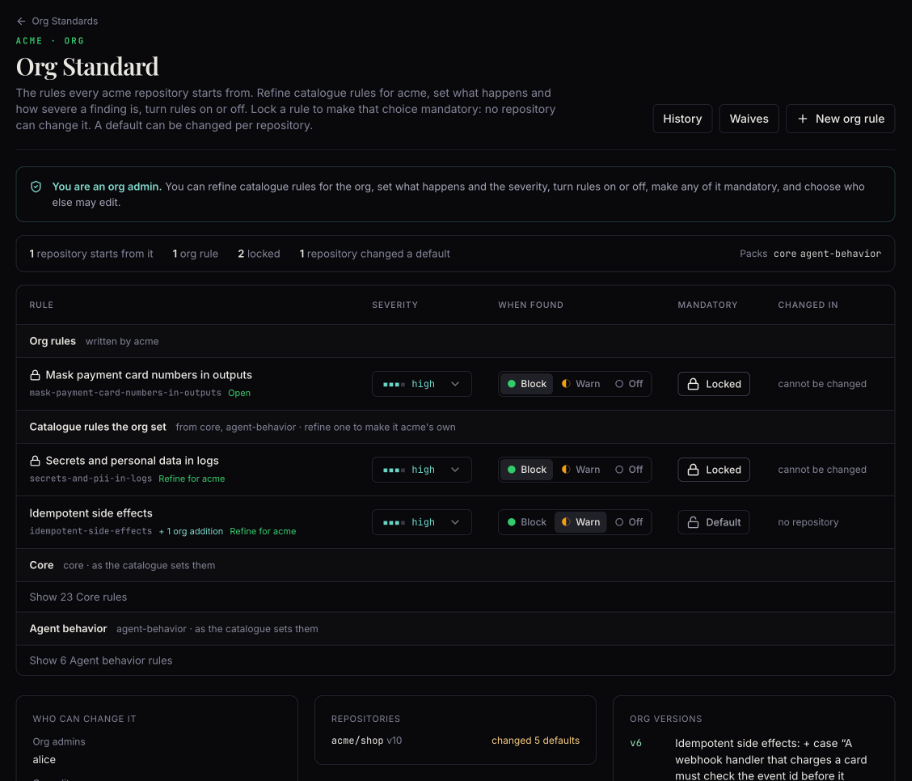
An org admin can make a rule mandatory. A lock holds what happens (Block, Warn or Off), the severity and whether the rule runs. Then:
- No repository can change them. The service refuses the save with
LOCKED_BY_ORG, also for an org admin who saves a repository Standard. - Only an org admin changes them, and only in the org Standard.
- A value that a repository set before the lock is no longer used. The repository's Standard page says so.
- A repository can still make the rule stricter: add a case on the web or in the terminal, or an example on the web. It cannot add a near miss or a path, or an example that holds a near miss, because those would loosen the rule.
When a change reaches reviews
Every review asks the service for the latest repository Standard and the latest org Standard. Nobody pulls anything: the next review after a save uses the new version.
.verity/standard.yaml is only a copy of the repository Standard, for reading and editing. Reviews do not read it. An org Standard has no file: it lives on the service.
Waives
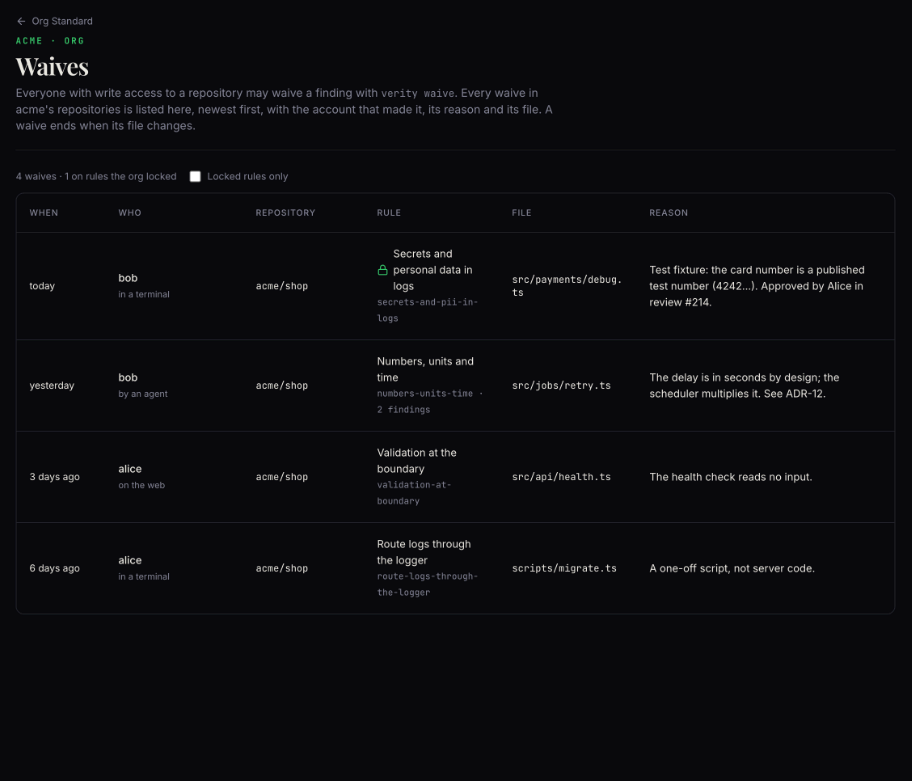
Everyone with write access can waive a finding with verity waive, also a finding of a locked rule. See Findings & verdicts for what a waive does. Each waive is recorded with the account that made it, the rule, the file and the reason, and whether the org had locked the rule.
Org admins read the record on the web: Org Standards, then the org, then Waives. Nobody else can open it. Waives made before 2026-11-16 show as “Not recorded”, because Verity did not record the account then.
Where to change it
- On the web: Standards on the web.
- In the terminal:
verity standard edit --org. See The terminal editor.